


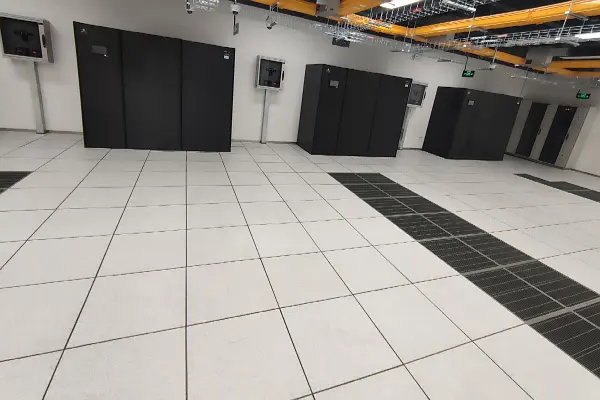
Raised access floors are used in data centers to create an accessible space between the structural floor and the finished floor surface. This underfloor space can be used for power cables, communication lines, cooling airflow, and other infrastructure required for data center operation.
Unlike conventional flooring systems, raised access floors consist of removable floor panels supported by adjustable pedestals and, depending on the system design, horizontal stringers. The system creates a modular floor platform that allows data center operators to access and modify underfloor infrastructure when equipment layouts or operational requirements change.
The main reasons for using raised access floors in data centers include cable management, airflow organization, equipment support, maintenance accessibility, and infrastructure flexibility.
What Is a Data Center Raised Access Floor?
A data center raised access floor is a modular flooring system installed above the original structural floor.
The system typically consists of floor panels, adjustable pedestals, and optional stringers. The height of the raised floor can be designed according to cable capacity, cooling requirements, equipment layout, and project specifications.
Depending on the project, data center raised floor panels may include steel cementitious panels, calcium sulphate panels, anti-static panels, and perforated airflow panels.
The removable panel structure allows technicians to access the space below the floor without extensive demolition or reconstruction.
Raised Access Floors Help Organize Data Center Cables
Modern data centers contain large quantities of power cables, network cables, fiber optic lines, and communication systems.
If these cables are installed directly across the floor or arranged without a structured cable management system, maintenance and future expansion can become more difficult.
Raised access floors provide dedicated underfloor space for cable routing and management.
Power cables and communication lines can be arranged beneath the floor panels according to the project design. When maintenance, equipment replacement, or infrastructure upgrades are required, selected panels can be removed to provide access to the underfloor space.
This approach can help improve cable organization and simplify infrastructure management.
Raised Floors Can Support Data Center Airflow Management
Airflow management is another important reason raised access floors are used in data centers.
In some data center designs, the underfloor space functions as an air distribution plenum. Cool air is supplied beneath the raised floor and delivered to specific equipment areas through perforated panels or airflow grilles.
The location and open area of perforated panels can be selected according to cooling requirements and equipment layout.
A properly designed raised floor cooling system can support more controlled airflow distribution. However, the performance of the system depends on several factors, including floor height, air pressure, panel arrangement, cooling capacity, and the overall data center design.
For this reason, raised access flooring should be considered as one part of the complete data center cooling and airflow management system.
Raised Access Floors Provide Support for Heavy Equipment
Data centers contain server racks, cabinets, UPS systems, cooling equipment, and other heavy infrastructure.
The raised access floor system must provide sufficient structural performance to support these loads safely.
Important performance considerations may include:
- Concentrated load
- Uniformly distributed load
- Rolling load
- Ultimate load
- Pedestal stability
- System stability
The required load capacity depends on the type of equipment, cabinet weight, transportation methods, and project specifications.
Selecting a data center floor based only on panel thickness or appearance is not recommended. The structural performance of the complete raised access floor system should be considered.
Raised Floors Make Data Center Maintenance More Convenient
Data center infrastructure may require regular inspection, maintenance, replacement, and upgrading.
With a conventional fixed floor system, accessing cables and services beneath the floor can be difficult.
Raised access floor panels are removable. Maintenance personnel can open specific areas of the floor to inspect cables, replace components, or modify infrastructure.
After the work is completed, the panels can be installed again.
This modular design can make maintenance and infrastructure adjustments more convenient, particularly in facilities where equipment configurations change over time.
Raised Access Floors Provide Greater Infrastructure Flexibility
Data centers are not always static environments.
New servers may be added. Equipment layouts may change. Cable capacity may increase. Cooling requirements may also change as computing density increases.
A raised access floor provides a flexible platform that can adapt to some of these changes.
Floor panels can be removed, replaced, or rearranged according to project requirements. Perforated panels can also be installed in designated locations when airflow distribution needs to be adjusted.
This flexibility is one of the reasons raised access floors continue to be considered for many data center and server room projects.
What Types of Raised Access Floors Are Used in Data Centers?
Different raised floor systems can be selected according to project requirements.
Steel Cementitious Raised Access Floor
Steel cementitious raised floor panels typically consist of a steel shell filled with lightweight cementitious material.
These panels are commonly selected for projects requiring structural stability, load capacity, and modular installation.
Different surface finishes can be selected according to the application requirements.
Calcium Sulphate Raised Access Floor
Calcium sulphate raised floor panels are manufactured from high-density calcium sulphate material.
They are used in data centers, offices, equipment rooms, and other commercial or technical environments.
Calcium sulphate panels can provide structural stability and are available with different surface finishes and edge designs.
Anti-Static Raised Access Floor
Anti-static raised access floors are used in environments where electrostatic discharge control is an important project consideration.
Depending on the system, HPL or other anti-static finishes may be applied to the panel surface.
The complete electrostatic control performance depends not only on the floor panel but also on system design, installation, grounding, and environmental conditions.
Perforated Raised Floor Panels
Perforated panels are used in raised floor cooling systems to deliver airflow from the underfloor space to equipment areas.
Different perforation rates and airflow characteristics are available according to cooling requirements.
The selection and placement of perforated panels should be coordinated with the data center airflow design.
How High Should a Data Center Raised Floor Be?
There is no single raised floor height suitable for every data center.
The appropriate height depends on factors such as:
- Cable quantity
- Cable tray arrangement
- Cooling system design
- Required underfloor airflow
- Equipment layout
- Maintenance requirements
- Project specifications
A lower floor height may be suitable for projects mainly requiring cable management, while data centers using underfloor air distribution may require greater space.
The final floor height should therefore be determined according to the complete infrastructure and cooling design rather than selected independently.
How to Choose a Raised Access Floor for a Data Center
Choosing a data center raised access floor requires consideration of both the floor panels and the complete support system.
Project designers and buyers should evaluate the required load capacity, floor height, panel material, surface finish, anti-static requirements, airflow management, installation conditions, and maintenance needs.
The equipment layout should also be considered.
Areas supporting heavy cabinets may have different structural requirements from general access areas. Locations requiring cooling airflow may need perforated panels, while other areas may use solid panels.
For this reason, a suitable data center raised flooring solution should be selected according to actual project conditions rather than using one specification for every application.
Are Raised Access Floors Necessary for Every Data Center?
Not every modern data center uses a raised access floor.
Some facilities use overhead cable management and alternative cooling systems.
Whether a raised floor is required depends on the data center design, cooling strategy, cable management system, equipment layout, maintenance requirements, and project budget.
However, raised access floors remain a practical option for many data centers and server rooms that require accessible underfloor infrastructure, modular installation, cable organization, or underfloor airflow distribution.
Frequently Asked Questions
What is the main purpose of a raised floor in a data center?
The main purpose is to create accessible space beneath the finished floor for cables, infrastructure, and, in some designs, cooling airflow. Raised floors can also support equipment installation and make future maintenance or infrastructure modifications more convenient.
Can raised access floors support heavy server cabinets?
Yes, but the floor system must be selected according to the required load capacity. Concentrated load, rolling load, uniform load, pedestal stability, and complete system performance should be evaluated according to the equipment and project specifications.
Are perforated panels necessary in a data center?
Not always. Perforated panels are mainly used when the raised floor system is part of the data center airflow distribution design. Their quantity and location depend on cooling requirements and equipment layout.
What materials are commonly used for data center raised floors?
Common options include steel cementitious raised floor panels and calcium sulphate raised floor panels. Anti-static finishes and perforated airflow panels can also be selected according to project requirements.
How do I choose the right raised floor for a data center project?
Consider the required load capacity, floor height, panel material, cooling strategy, cable management, anti-static requirements, equipment layout, installation conditions, and project specifications before selecting the floor system.
Conclusion
Raised access floors are used in data centers because they provide an organized and accessible platform for cables, infrastructure, equipment support, and, in some designs, cooling airflow.
Their modular structure can make installation, maintenance, and future infrastructure adjustments more convenient. However, the appropriate raised floor system depends on the actual requirements of each project, including load capacity, floor height, airflow design, panel material, and equipment layout.
For data center and server room projects, evaluating the complete raised access floor system according to project conditions is an important part of selecting a suitable flooring solution.