


Introduction
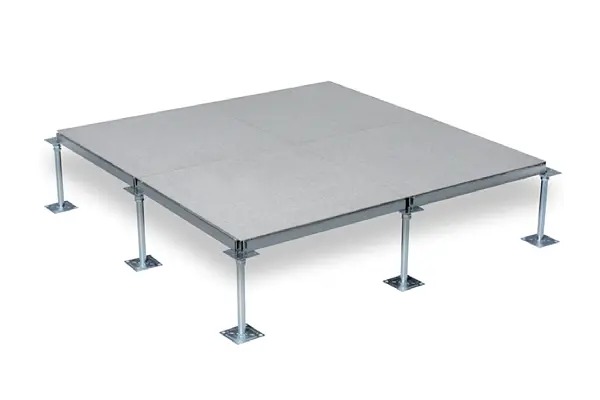
When selecting a raised access flooring system, two of the most common options are steel raised access floors and calcium sulphate raised floors. Both provide an accessible underfloor space for cables, HVAC systems, and building services, but they differ in structure, performance, and ideal applications.
Understanding these differences helps architects, contractors, and facility managers choose the most suitable solution for long-term performance and maintenance.
What Is a Steel Raised Access Floor?
A steel raised access floor typically consists of welded steel panels filled with lightweight cementitious material. The panels are supported by adjustable pedestals and can be combined with stringers for additional stability.
Key characteristics include:
- High mechanical strength
- Excellent dimensional stability
- Good impact resistance
- Suitable for heavy equipment loads
- Compatible with HPL, PVC, ceramic, or conductive finishes
Steel systems are commonly used in data centers, commercial offices, and telecommunications facilities.
What Is a Calcium Sulphate Raised Floor?
Calcium sulphate raised floors use high-density calcium sulphate cores instead of steel-filled panels. These panels are manufactured under high pressure to provide excellent load-bearing performance while maintaining environmental sustainability.
Typical features include:
- Dense homogeneous structure
- Good acoustic performance
- Stable dimensional properties
- High fire resistance
- Low VOC emissions
They are widely used in offices, libraries, control rooms, and premium commercial buildings.
Comparison of Key Performance
| Feature | Steel Raised Floor | Calcium Sulphate Floor |
|---|---|---|
| Load Capacity | Excellent | Excellent |
| Impact Resistance | Very High | High |
| Moisture Resistance | Good with proper coating | Stable under controlled conditions |
| Fire Performance | Very Good | Very Good |
| Acoustic Performance | Good | Excellent |
| Weight | Moderate | Heavier |
| Maintenance | Easy | Easy |
| Typical Cost | Competitive | May vary depending on specification |
Both systems can provide reliable service when properly installed and maintained.
Which Applications Prefer Steel Raised Floors?
Steel raised access floors are often selected for:
- Data centers
- Server rooms
- Telecommunication facilities
- Command centers
- Equipment rooms
- Industrial control spaces
Their robust construction makes them suitable for environments with concentrated equipment loads and frequent maintenance access.
Which Projects Benefit from Calcium Sulphate Floors?
Calcium sulphate systems are commonly used in:
- Grade A office buildings
- Libraries
- Educational facilities
- Financial institutions
- Public administration buildings
- Commercial interiors requiring enhanced acoustic comfort
Their dense core and stable performance make them attractive for projects emphasizing occupant comfort.
Maintenance Considerations
Regardless of panel type, routine maintenance helps maximize service life:
- Inspect pedestals and panel alignment periodically.
- Replace damaged finishes promptly.
- Keep underfloor spaces clean and dry.
- Avoid exceeding specified design loads.
- Verify access panels remain securely seated after maintenance work.
Preventive inspections reduce unexpected downtime and preserve floor performance.
How to Choose the Right Raised Floor System
Selection should consider multiple project factors rather than material alone:
- Expected equipment loads
- Building function
- Cable management requirements
- Environmental conditions
- Fire safety requirements
- Future maintenance access
- Budget and lifecycle expectations
Working with an experienced supplier can help ensure the flooring system matches the operational needs of the facility.
Conclusion
Both steel raised access floors and calcium sulphate raised floors offer dependable performance for modern buildings. Steel panels are often preferred for equipment-intensive environments, while calcium sulphate panels are frequently chosen for commercial spaces where acoustic performance and stable structural characteristics are priorities.
The best solution depends on the specific requirements of each project, including load expectations, building use, maintenance strategy, and long-term operational goals.