


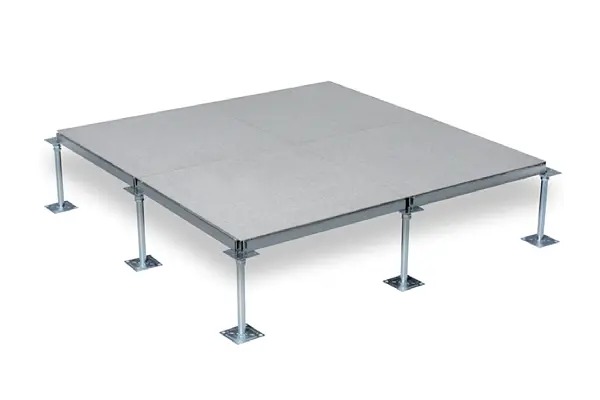
The required load capacity for a data center raised floor depends on the weight and arrangement of server cabinets, UPS systems, cooling equipment, maintenance tools, and other infrastructure installed or transported across the floor.
There is no single load capacity suitable for every data center project.
A small server room and a large data center may have very different structural requirements. Even within the same facility, general access areas and locations supporting heavy equipment may require different load considerations.
When selecting a raised access floor, buyers should understand the main load performance indicators, including concentrated load, uniformly distributed load, rolling load, and ultimate load.
The complete raised floor system should then be evaluated according to actual equipment loads and project requirements.
Why Is Load Capacity Important for Data Center Raised Floors?
Data centers contain equipment that can place significant loads on the flooring system.
Server cabinets, battery systems, UPS equipment, cooling units, and other infrastructure may be installed above the raised floor.
Heavy equipment may also need to be moved across the floor during installation, maintenance, replacement, or facility upgrades.
If the selected raised access floor system does not provide suitable structural performance, problems may occur during installation or long-term use.
For this reason, load capacity should be evaluated during the floor selection stage rather than after equipment has already been installed.
What Does Raised Floor Load Capacity Mean?
Raised floor load capacity describes the ability of the flooring system to support different types of loads.
However, a single load value cannot fully describe the structural performance of a raised access floor.
Several load indicators are commonly considered:
- Concentrated load
- Uniformly distributed load
- Rolling load
- Ultimate load
- Pedestal capacity
- Complete system stability
Each indicator represents a different operating or testing condition.
Understanding these differences is important when comparing raised floor products for data centers and server rooms.
What Is Concentrated Load?
Concentrated load is one of the important performance indicators for raised access floor panels.
It refers to a load applied to a relatively small area of the floor panel.
This type of load is particularly relevant in data centers because server cabinets and technical equipment may transfer weight to the floor through feet, casters, or other limited contact areas.
For example, a heavy cabinet does not necessarily distribute its total weight evenly across an entire floor panel.
The actual load may be concentrated at several support points.
For this reason, buyers should not evaluate a data center raised floor only according to the total weight of the equipment.
The equipment footprint and load distribution should also be considered.
What Is Uniformly Distributed Load?
Uniformly distributed load refers to a load spread across a larger floor area.
This value can help describe the overall load-bearing performance of a raised floor system under distributed loading conditions.
However, data center equipment frequently creates localized loads rather than perfectly uniform loads.
Therefore, uniformly distributed load should not be the only structural indicator considered when selecting a data center raised access floor.
Concentrated load, rolling load, equipment layout, and the complete flooring system should also be evaluated.
What Is Rolling Load?
Rolling load describes the ability of a raised floor system to withstand loads moving across the floor surface.
This is particularly important for data centers.
During equipment installation and maintenance, heavy cabinets, servers, UPS equipment, and other components may be transported using carts, pallet trucks, or other wheeled equipment.
A floor panel may therefore experience repeated moving loads.
Rolling load requirements can be different from static equipment loads.
When heavy equipment needs to be transported across the raised floor, the expected equipment weight, wheel type, wheel size, transportation route, and floor protection measures should be considered.
What Is Ultimate Load?
Ultimate load refers to the load level at which a floor panel or system reaches structural failure under specified test conditions.
It is different from the recommended working load.
Buyers should not select a raised floor based on ultimate load alone.
The working conditions, safety requirements, equipment loads, and relevant testing standards should all be considered.
A suitable raised floor system should provide structural performance appropriate for normal project operation rather than simply having a high maximum test value.
How Much Load Does a Data Center Raised Floor Need to Support?
There is no universal answer.
The required load capacity depends on the actual data center design.
Important factors include:
- Server cabinet weight
- UPS equipment weight
- Battery systems
- Cooling equipment
- Equipment support points
- Equipment transportation methods
- Maintenance activities
- Raised floor height
- Pedestal system
- Project specifications
A general server room containing relatively light cabinets may have different requirements from a high-density data center containing heavy technical equipment.
For this reason, the required load capacity should be determined according to actual project information.
How Should Server Cabinet Weight Be Evaluated?
When evaluating server cabinet loads, the total cabinet weight is only one part of the calculation.
The load distribution should also be considered.
Important information includes:
- Empty cabinet weight
- Installed equipment weight
- Total operating weight
- Number of support feet or casters
- Contact area
- Cabinet dimensions
- Cabinet position
For example, two cabinets with the same total weight may create different loads on the raised floor if their support points and equipment arrangements are different.
Understanding how the equipment transfers load to the flooring system can help with more appropriate floor selection.
Are Heavy-Duty Raised Floors Always Better for Data Centers?
Not necessarily.
A higher load capacity may be required for some projects, but selecting the highest available load rating is not automatically the most suitable solution.
The floor system should match actual project requirements.
Over-specifying the flooring system may increase project costs without providing meaningful benefits.
Under-specifying the floor can create structural and operational risks.
The objective should therefore be to select a raised access floor with suitable performance according to equipment loads, installation conditions, maintenance requirements, and project specifications.
Does Raised Floor Material Affect Load Capacity?
Raised access floor panels are available in different materials and structures.
Common options for data center projects include steel cementitious raised floors and calcium sulphate raised floors.
However, buyers should not assume that one material always provides higher load capacity than another.
Structural performance depends on factors such as:
- Panel construction
- Material density
- Panel thickness
- Steel structure
- Pedestal system
- Stringer design
- Installation method
- Complete system configuration
For this reason, specific technical data should be compared rather than selecting a product based only on material type.
Steel Raised Floor Load Capacity
Steel cementitious raised floor panels typically consist of a steel shell filled with lightweight cementitious material.
Different panel structures and specifications can provide different load performance.
Steel raised floors are commonly used in data centers, server rooms, control rooms, offices, and other technical environments.
When selecting a steel raised floor, buyers should compare concentrated load, rolling load, ultimate load, panel dimensions, pedestal systems, and project requirements.
Calcium Sulphate Raised Floor Load Capacity
Calcium sulphate raised floor panels are manufactured from high-density calcium sulphate material.
They are also used in data centers, offices, equipment rooms, and commercial buildings.
Different panel thicknesses, densities, structures, and support systems can provide different structural performance.
As with steel raised floors, the specific product data and complete flooring system should be evaluated according to the project requirements.
Does Raised Floor Height Affect Load Performance?
Raised floor height can affect the design requirements of the support system.
As the finished floor height increases, pedestal stability and the complete support structure become increasingly important considerations.
Depending on the project, additional structural measures may be required.
The appropriate system design depends on:
- Finished floor height
- Equipment loads
- Pedestal type
- Stringer system
- Lateral stability
- Installation conditions
Buyers should therefore consider both floor panel performance and support system design.
Are Stringers Required for Heavy Data Center Equipment?
Whether stringers are required depends on the raised floor system and project requirements.
Stringers connect adjacent pedestal heads and can provide additional lateral stability.
Some data center flooring systems use stringers, while other systems may use different structural designs.
The decision should be based on factors including:
- Raised floor height
- Equipment load
- Panel type
- Pedestal system
- Required stability
- Project specifications
Stringers should be considered as one part of the complete system rather than evaluated independently.
What About Heavy Equipment Transportation?
Heavy equipment transportation is an important consideration that can sometimes be overlooked during raised floor selection.
A floor system may support stationary equipment under normal operating conditions but experience different stresses when heavy equipment is moved across the surface.
Before transporting heavy equipment, consider:
- Total equipment weight
- Wheel loads
- Wheel dimensions
- Transportation route
- Floor panel capacity
- Pedestal system
- Temporary floor protection
In some projects, temporary load distribution plates or other protective measures may be used during heavy equipment transportation.
The appropriate method should be determined according to the equipment and flooring system.
Should Every Area of a Data Center Use the Same Raised Floor?
Not necessarily.
Different areas of a data center may have different loading and functional requirements.
For example:
General access areas may mainly support personnel and normal equipment.
Server cabinet areas may experience higher concentrated loads.
Equipment transportation routes may require consideration of rolling loads.
Cooling areas may use perforated panels.
UPS or battery areas may have specific structural requirements.
For this reason, floor selection and layout should be coordinated with the equipment and infrastructure design.
How to Choose Data Center Raised Floor Load Capacity
The selection process should begin with actual project information.
Step 1: Identify the Equipment
List the server cabinets, UPS systems, cooling equipment, battery systems, and other heavy infrastructure.
Step 2: Confirm Equipment Weight
Determine the operating weight rather than considering only the empty equipment weight.
Step 3: Evaluate Load Distribution
Check the equipment dimensions, feet, casters, and contact areas.
Step 4: Consider Equipment Transportation
Determine how equipment will be moved into and across the facility.
Step 5: Confirm the Raised Floor Height
Consider the relationship between floor height and support system requirements.
Step 6: Compare Technical Specifications
Evaluate concentrated load, rolling load, ultimate load, and complete system performance.
Step 7: Consider Project Requirements
Review drawings, technical specifications, testing requirements, and installation conditions.
Following this process can help buyers and project teams select a raised floor system based on actual operating conditions.
What Information Should You Provide to a Raised Floor Supplier?
When requesting a data center raised floor recommendation or quotation, providing complete project information can improve product selection.
Useful information includes:
- Project application
- Project area
- Project location
- Floor panel type
- Required quantity
- Finished floor height
- Server cabinet weight
- Heavy equipment information
- Required load capacity
- Surface finish
- Anti-static requirements
- Perforated panel requirements
- Project drawings
If the required load capacity has not yet been determined, equipment information and project conditions can still help with initial system selection.
Frequently Asked Questions
What is the most important load rating for a data center raised floor?
There is no single load rating that determines complete floor performance. Concentrated load, rolling load, ultimate load, equipment weight, load distribution, and complete system stability should be evaluated together.
Can a raised floor support heavy server cabinets?
Yes, if the floor system is selected according to the actual cabinet weight, load distribution, pedestal system, and project requirements.
What is the difference between concentrated load and uniform load?
Concentrated load is applied to a relatively small area, while uniformly distributed load is spread across a larger floor area. Data center equipment can create significant concentrated loads through cabinet feet or casters.
Why is rolling load important in data centers?
Heavy equipment may need to be moved across the raised floor during installation and maintenance. Rolling loads can create different stresses from stationary equipment loads.
Are steel raised floors stronger than calcium sulphate raised floors?
Not necessarily. Load performance depends on the specific panel structure, material, thickness, pedestal system, and complete flooring configuration. Specific technical data should be compared.
Conclusion
The required load capacity for a data center raised floor should be determined according to actual equipment, infrastructure, and operating conditions.
Concentrated load, uniformly distributed load, rolling load, ultimate load, equipment weight, floor height, pedestal stability, and system design are all important considerations.
Instead of selecting a floor based only on a single load value or panel material, buyers should evaluate the complete raised access floor system.
By providing detailed project and equipment information, data center designers, contractors, and buyers can select a flooring system that better matches the structural and operational requirements of the facility.