


In data center projects, raised floor load ratings are often misunderstood. Many failures are not caused by poor floor quality, but by incorrect load assumptions during design and specification.
Why Load Ratings Matter in Data Centers
In data centers, raised floor systems support not only static equipment loads but also dynamic operational demands. Server racks, cooling units, maintenance activities, and future capacity expansion all place stress on the floor structure.
When load ratings are misunderstood or simplified during design, problems often appear months or years later. Panels may deform, pedestals can loosen, and long-term structural reliability becomes uncertain. In many reported failures, the root cause is not material quality, but incorrect load assumptions made at the specification stage.
Understanding load ratings is therefore a risk-control issue rather than a purely technical parameter. Correct interpretation helps engineers design safer systems, avoid liability disputes, and ensure long-term stability of data center operations.
What Is Uniform Load?
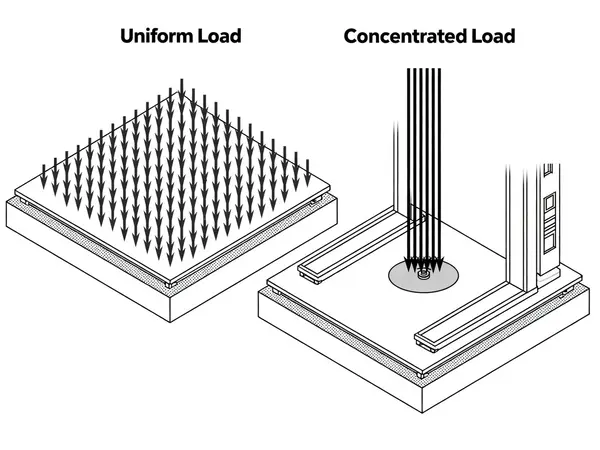
Uniform load refers to a load that is evenly distributed across the entire surface of a raised floor panel. It represents the overall weight that a panel can safely support when the load is spread uniformly, such as the combined weight of light equipment, cables, and floor finishes.
Uniform load values are commonly expressed in kilograms per square meter (kg/m²) or pounds per square foot (psf). These values are useful for evaluating general floor capacity but do not reflect localized stresses caused by heavy equipment.
In data center environments, uniform load alone is rarely the limiting factor. Relying solely on uniform load ratings may lead to overconfidence in floor performance when heavy point loads are present.
What Is Concentrated Load?
Concentrated load describes the maximum load that a raised floor panel can withstand when force is applied to a small, localized area. This scenario typically occurs under server rack feet, equipment casters, or maintenance tools.
Unlike uniform load, concentrated load directly reflects the most critical stress condition in data centers. Even when overall floor loading is low, localized pressure can exceed structural limits and cause panel deflection or failure.
For this reason, concentrated load is often the primary design criterion for data center raised floors. Engineers should always evaluate concentrated load capacity in relation to actual equipment footprints and support conditions.
Typical Mistakes in Raised Floor Selection
One common mistake is assuming that thicker panels automatically provide higher load performance. While panel thickness is a factor, structural design, material composition, and pedestal systems play equally important roles.
Another frequent error is using uniform load values to judge suitability for heavy server racks. This approach ignores localized stress and may result in long-term deformation or instability.
Finally, many projects fail to consider future upgrades. Data center loads tend to increase over time, and floors specified only for current conditions may not provide sufficient safety margins.
For a more detailed discussion on installation considerations, refer to anti-static raised floor installation requirements in computer rooms.
How to Choose the Right Raised Floor System
Selecting a raised floor system for data centers should begin with a realistic assessment of equipment weight, footprint dimensions, and operational requirements.
For critical facilities, a properly specified data center raised floor system helps ensure long-term structural stability and operational safety.
Engineers should also evaluate pedestal spacing, stringer systems, and installation quality, as these factors directly affect load transfer and system stability. When in doubt, conservative design assumptions help reduce long-term risk.
A well-specified raised floor system supports not only current operations but also future expansion, maintenance activities, and evolving equipment configurations.
Quick Checklist for Specifying Loads
Before finalizing a raised floor specification, engineers should confirm the following points:
- Maximum equipment weight and footprint size
- Concentrated load rating of floor panels
- Pedestal and stringer configuration
- Safety margin for future upgrades
- Compliance with applicable data center standards
Using this checklist helps reduce design errors and ensures that load performance aligns with real-world operating conditions.
FAQs
Is uniform load sufficient for data center floor design?
No. Uniform load alone does not account for localized stresses caused by heavy equipment and should not be used as the sole design criterion.
Why is concentrated load more important?
Because data center equipment applies force through small contact areas, concentrated load directly reflects the most critical structural condition.
Can load problems appear years after installation?
Yes. Long-term deformation and instability often develop gradually due to underestimated concentrated loads.